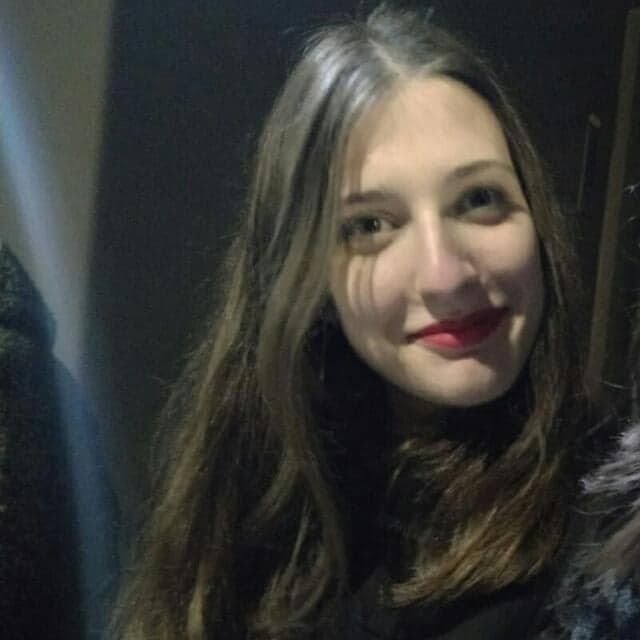
Degree: Master

Bio

Ana Cunha Ferreira graduated from the Faculty of Science of the University of Porto (FCUP) with a First Degree in Biochemistry in 2020 and a Master's Degree in Science Education and Communication in 2022.

She is currently enrolled in the Doctoral Program in Science Education and Communication since 2023. In the context of her thesis project, she will work and specialise in the field of Science Communication.

She has participated in several congresses with oral presentations and publications in proceedings.

She is currently a research fellow on the project ERASMUS+ STEAM Tales: Enhancing STEAM education through storytelling and hands-on learning, which aims to promote STEAM education through storytelling and hands-on activities to increase girls' interest in STEAM subjects and potentially STEAM professions in the future.

Her research interests are in the field of Science Communication, with a focus on the communication of scientific information to children, the analysis of news about science in the context of societal developments, and the landscape of different scientific fields in society.

Projects
This CIQUP member does not yet have any projects linked with him.
Publications
Total 1 publications.
1. Chemistry in early childhood: storytelling and hands-on water-based activities to foster scientific concepts and ideas, Morais, C Ferreira, A Araújo, JL Moreira, L in CHEMISTRY EDUCATION RESEARCH AND PRACTICE, 2026, ISSN: 1109-4028,  Volume: 27, 
Article,  Indexed in: crossref, wos, scopus, unpaywall  DOI: 10.1039/d5rp00271k P-01A-MJ8
Abstract In a societal context where chemistry is often perceived negatively, it is essential to promote educational approaches that foster meaningful and engaging learning experiences from an early age. This study aimed to explore how the integration of storytelling and hands-on activities can contribute to primary school children's engagement and understanding of scientific concepts, leading to a more meaningful chemistry learning. The research was conducted in four primary schools in the northern region of Portugal, involving 237 third- and fourth-grade students in non-formal educational initiatives. A qualitative methodology was employed, based on the analysis of students' laboratory notebooks. The intervention consisted of a dramatized story from the book Hist & oacute;rias com Qu & iacute;mica [Stories with Chemistry], followed by three water-based hands-on activities addressing key chemical concepts: acid-base reactions, supersaturated solutions, and redox processes. Children's responses were analysed using framework theory, which enabled the categorization of their conceptual development. The findings showed that students' responses progressed from simple sensory observations and intuitive explanations to the construction of basic scientific models. High levels of participation, engagement, and enthusiasm were observed throughout the activities. These results suggest that combining storytelling with hands-on experimentation represents a promising pedagogical strategy for introducing chemistry concepts in early education and promoting a more positive and accessible image of this science.